Residential roofing
Roof repair in Northwest Arkansas and the River Valley
Leaks, storm and hail damage, worn or missing shingles, flashing and pipe boots. Every repair starts with a free inspection, and the drone does the climbing.
Chapter 01
Why a roof starts to leak in this part of Arkansas
Take the guess-work out of storms. A roof leak is a sure sign that the roof is damaged and needs attention, and it usually shows up first as discoloration on a wall or a ceiling. When you see water damage like that, it is time for an inspection to find out how far the damage goes, before a small problem grows.
Northwest Arkansas and the River Valley get heat, high winds, hail, snow and ice, and each one finds a different weak point. Hail bruises shingles and wind lifts them. After a snowfall, a clogged gutter can back ice up along the eave, so the melted snow cannot run off the roof. That is called ice damming, and it can affect every part of the roof.
Even a minor leak can cause major damage in the long run, so the right time for a professional assessment is the first sign of water getting in. Do your roof maintenance when the weather is fair, and call us if you think there is damage.
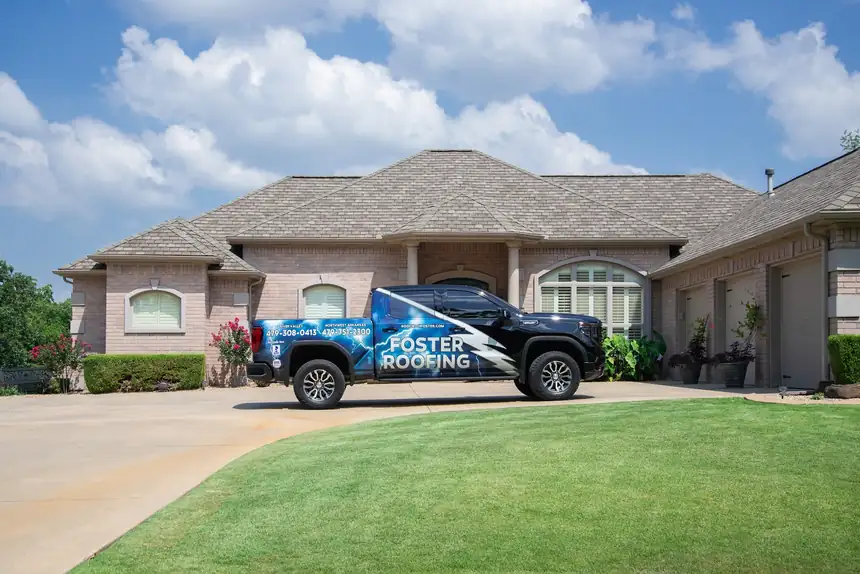
A Foster Roofing truck parked on the drive of a brick home with a finished roof
How a repair inspection works
Every repair starts with a free roof inspection. Our drones capture high-resolution photos and video of the roof, which lets us look at steep, high or hard-to-reach areas without foot traffic on your shingles. The images help identify leaks, storm damage, missing shingles, flashing issues and general wear.
You do not have to be home, though it is a good idea to be there so the sales rep can explain what was found. The rep goes through the results and the scope of work during that first visit, and you learn what is needed to correct the problem and the estimated cost.
Chapter 03
What a Foster roof repair covers
Most roof problems can be repaired, and the goal is a roof that reaches its expected lifespan. Our contractors address most issues by adjusting shingles or nail placement, and we look for the solution that saves you time and money. The inspection also tells you whether repair or full replacement is the better option.
The repair list includes leak detection and sealing, storm and hail damage repair, shingle replacement, flashing fixes, and vent and pipe boot repairs. Preventative maintenance inspections are on it too, because a small problem caught in fair weather stays small. We are the repair specialists for Bentonville, Rogers, Springdale, Fayetteville, Fort Smith, Alma, Van Buren and Greenwood, along with the rest of Northwest Arkansas and the River Valley.
How a repair gets paid for
If storm damage is behind the leak, you may file an insurance claim. Our insurance claims specialists are trained to assess roof damage accurately, which makes the repair or replacement process easier from the very start, and we give you the damage documentation and details you need to file with your own insurance company.
If you are not filing a claim, we offer financing with approved credit through Wells Fargo, and we accept cash, check and credit cards. A 3% processing fee applies to any card transaction. Both offices are open Monday to Friday, 8:00 AM to 5:00 PM.
Arkansas State Licensed #0156360427, locally owned and operated since 1994, with an A+ rating from the Better Business Bureau in both Springdale and Fort Smith.
The usual suspects
Six causes of a leaking roof
These are the causes Foster Roofing names for a roof that lets water in. If the leak turns out to be the roof reaching the end of its life, our roof replacement page explains how that decision gets made. If a storm caused it, see how insurance claim help works.
Hail impact and other storm damage
Hail bruises shingles and wind lifts or tears them, and the leak often appears weeks after the storm.
Improper installation or faulty metal flashing
Flashing seals the joints where a roof meets a wall, a chimney or a vent, so when it is poorly fitted or fails, water finds the gap.
Fallen tree limbs
A limb that lands on the roof can crack or puncture the shingles and the deck under them.
Other companies walking on your roof
Other trades that service a roof can crack shingles and disturb flashing just by walking on them.
Old, cracked or sun-damaged shingles
Shingles that have dried out and cracked stop shedding water where they lie.
Clogged gutters
After a snowfall a clogged gutter backs ice up at the eave, which is the ice damming described above.